
Compatible formulations
The Models browser lists rule-of-mixtures variants, Halpin–Tsai, Chamis, Mori–Tanaka, Hashin–Rosen, self-consistent, woven bridging and Cox elastic short-fiber choices. Architecture determines which choices are available.
Workflow / 03.2 Micromechanics
Choose a released architecture-compatible homogenization model, inspect its reference ply properties, and carry those properties into the laminate.
Explore plain, twill and satin yarn surfaces in Micro, Live Stack, CREATE and DISCOVER. Switch between one repeat and 2 × 2 or 3 × 3 cells, then rotate and zoom. CREATE carries the selected weave and woven bridging model into SIMULATE, subject to your license.
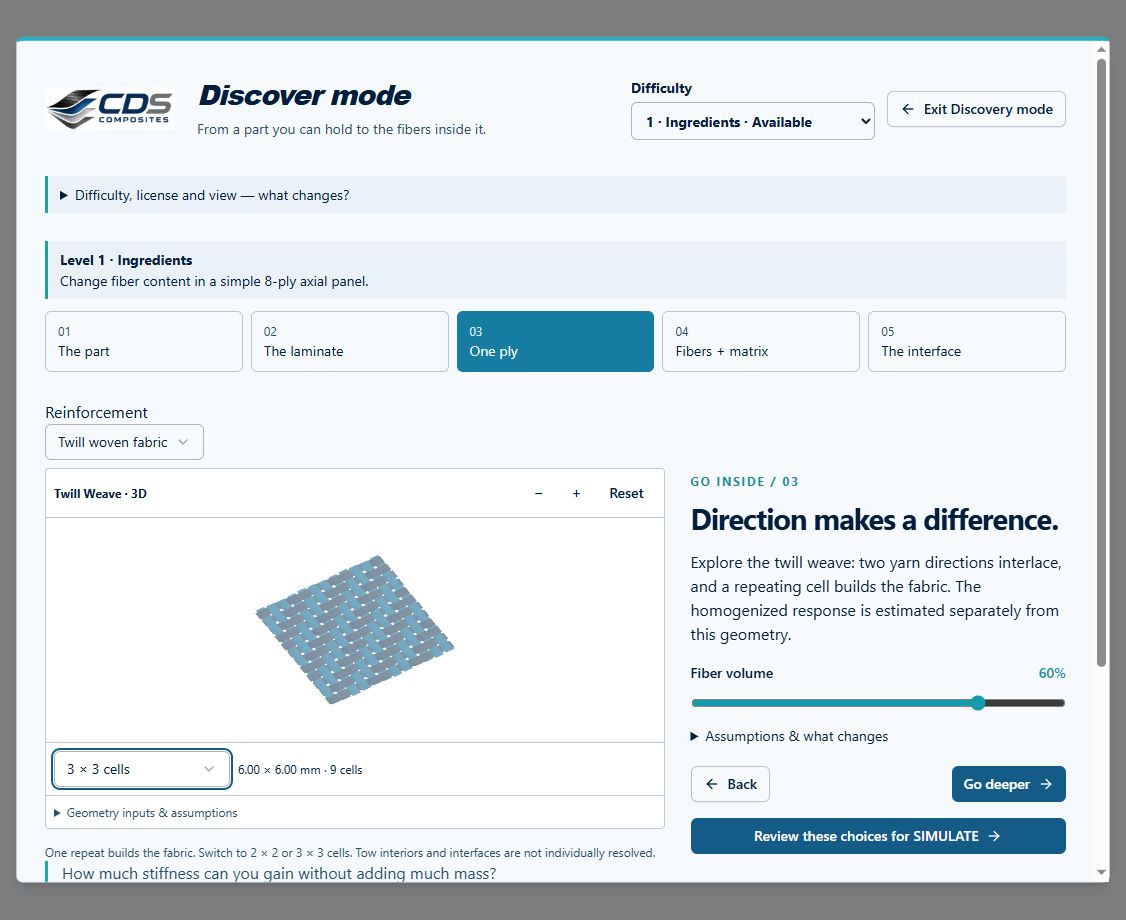
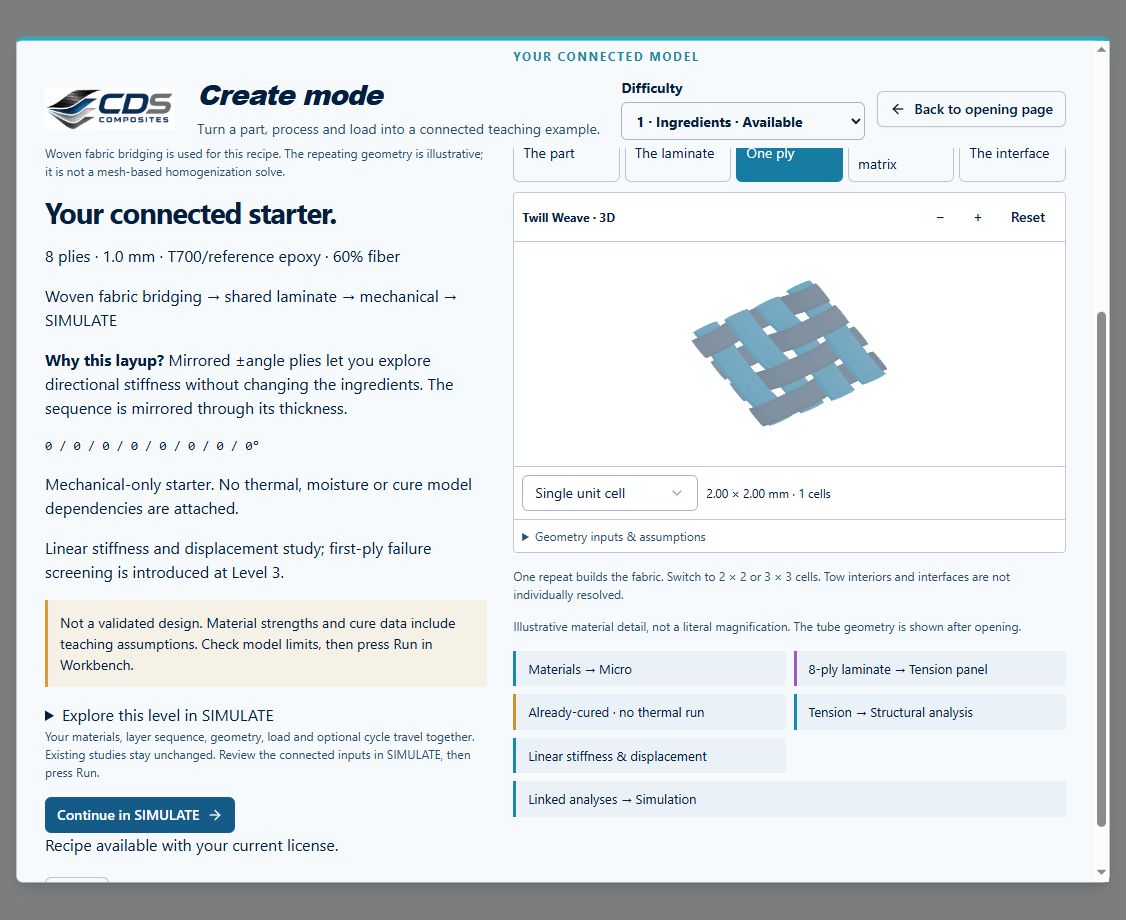
Captured from the Workbench components in a local preview, September 17, 2026. Missing yarn dimensions are inferred and listed under Geometry inputs & assumptions. These are periodic surface illustrations—not measured textile CAD, solid exports or a mesh-based solver. Effective properties are calculated separately by the selected micromechanics model.
Zero-stiffness void phase; no empirical void knockdown or transverse prediction.
03.2 / Workflow focus
Connected engineering recordThe Models browser lists rule-of-mixtures variants, Halpin–Tsai, Chamis, Mori–Tanaka, Hashin–Rosen, self-consistent, woven bridging and Cox elastic short-fiber choices. Architecture determines which choices are available.
Cox shear-lag elastic studies use prescribed geometry and orientation. The event-driven Henry–Pimenta RVE and its stochastic discontinuous-fiber failure route are not enabled in the hosted release.
The selected Micro recipe supplies reference properties to its linked plies. Shared material or Micro edits can change multiple laminate calculations.
Use an exercise or supported property sweep to compare model assumptions, constituent limits and sensitivity. Predicted strengths and teaching defaults are not qualified allowables.
Workbench availability: released models, inputs and compatible study paths. The wider theory library includes reference formulations not available in every Workbench solve.
Use this workflow in Workbench: interactive Blocks, record selections and connection controls →
Connected model layer
Expand a family for inputs, outputs, supported formulations, theory and an exercise. All model families ↗
Design a ply or reinforced feedstock
Models browser → Micromechanics · source: Micro
One compatible homogenization model per Micro recipe. Use separate recipes for comparisons; they are not combined in a single ply.
Design dielectric mixtures, shielding and periodic layers
Models → Electromagnetics · RF → Wiener series and parallel
Positive lossless dielectric bounds; complex directional estimates.
Models → Electromagnetics · RF → Looyenga / Landau–Lifshitz–Looyenga
One cube-root mixing law, not two independent models.
Models → Electromagnetics · RF → Maxwell–Garnett
Dilute subwavelength spherical inclusions in a host.
Models → Electromagnetics · RF → Bruggeman symmetric EMT
Two positive-permittivity phases; no explicit contact network.
Models → Electromagnetics · RF → EM Mori–Tanaka
Scalar principal-axis ellipsoidal field approximation.
Models → Electromagnetics · RF → EM self-consistent
Scalar principal-axis self-consistency; spherical case equals Bruggeman.
Models → Electromagnetics · RF → Differential effective medium
Incremental mixing with time-step refinement check.
Models → Electromagnetics · RF → Coated sphere and interphase
Concentric subwavelength coated spheres; no dynamic Mie scattering.
Models → Electromagnetics · RF → Generalized multiphase EMT
Spherical multiphase Bruggeman with convergence checks.